How Meridiae Produces Intelligence
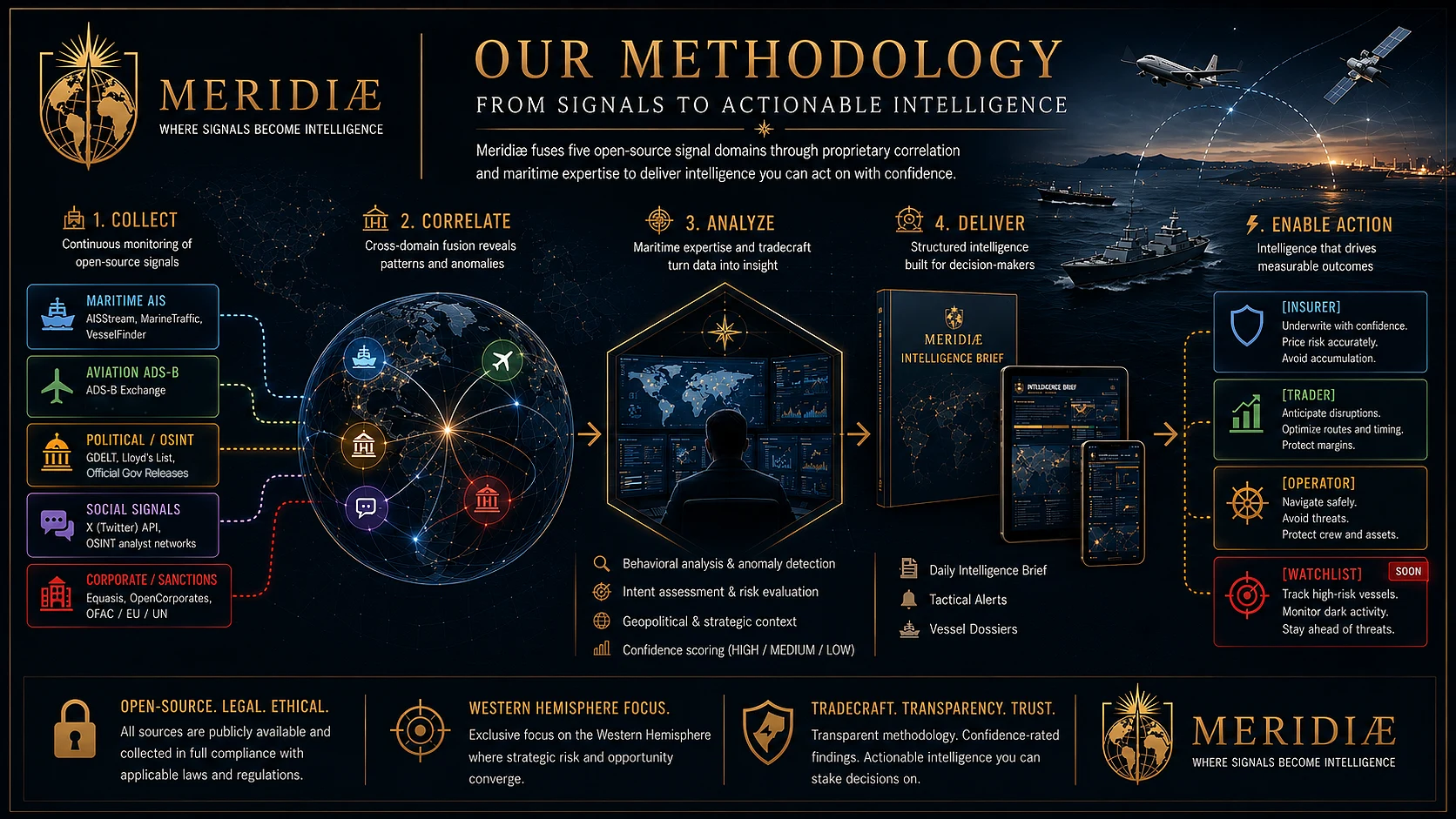
Data Domains
Automatic Identification System (AIS)
Vessel position, heading, speed, and identity broadcasts transmitted by commercial ships under international maritime law. AIS is self-reported and manipulable — transponders can be switched off, spoofed, or falsified. Gaps, anomalies, and inconsistencies in AIS records are themselves primary intelligence signals, not data quality problems to be filtered out.
ADS-B and Aviation Tracks
Open aircraft transponder data covering commercial, charter, and — where visible — government and surveillance aviation. When aircraft movements correlate with maritime anomalies in time and geography, the intersection warrants analytical attention. ISR assets, coast guard aviation, and unscheduled maritime patrol activity leave signatures in ADS-B.
Commercial Imagery and Geospatial Context
Publicly available satellite imagery, port activity indicators, and geospatial reference data used to corroborate or challenge position reports. Vessel shadows, anchor patterns, port berth occupancy, and coastal infrastructure changes are observable from open sources at resolution sufficient for assessment.
Open-Source Reporting and Registry Data
Regional and international media, shipping industry publications, sanctions databases, flag state registries, and cargo manifests — used to establish vessel identity, beneficial ownership chains, historical behavioral patterns, and geopolitical context. A vessel's declared identity is a claim; registry and ownership data are the means of verification.
Analytical Approach
No single signal is treated as conclusive. Meridiae applies an anomaly-first framework: deviations from expected behavior — in position, timing, speed, transponder status, or route — trigger investigation, not assumption.
Correlation across independent domains is the core discipline. Consider the difference:
| Signal | Analytical Value | Confidence |
|---|---|---|
| Vessel goes AIS-dark | Possible evasion. Common. Many benign causes. | Low |
| AIS-dark in known transfer zone | Elevated suspicion. Pattern match to STS behavior. | Moderate |
| AIS-dark + unscheduled aviation overhead + declared destination contradicts last heading | Multi-domain convergence. Consistent with active sanctions evasion operation. | High |
Each additional independent signal that converges on the same assessment increases analytical confidence — not because signals reinforce each other narratively, but because the probability of coincidental alignment across independent domains decreases with each layer.
Output Standards
Every Meridiae brief explicitly distinguishes between:
- Observation — what the data shows, stated without interpretation
- Assessment — what it likely means, given context and pattern
- Confidence level — how certain we are, and what would change the assessment
Assessments are falsifiable. Where the data is ambiguous, that ambiguity is stated, not resolved artificially. A brief that projects false certainty is not an intelligence product — it is noise dressed as signal.
What We Do Not Claim
Open-source intelligence has genuine limits. Vessel identity can be falsified at layers we cannot independently verify. Ownership chains can be obscured behind jurisdictions that do not publish registry data. ADS-B coverage has gaps. We work within these constraints honestly.
The Autonomy Disclosure
Meridiae briefs are produced by an AI-assisted analytical pipeline. Signal collection, pattern detection, correlation, and initial draft synthesis are performed programmatically. This is disclosed on every brief because it is material: the speed and scale that make daily maritime intelligence economically viable are inseparable from the automation that produces it.
We believe the right response to AI-assisted intelligence is transparency about the process, rigorous output standards, and explicit confidence labeling — not the pretense of human-only authorship.
Contact
Questions about methodology, data sources, or analytical standards: intelligence@meridiae.com